
Buckwheat Roasted Garlic Ramen
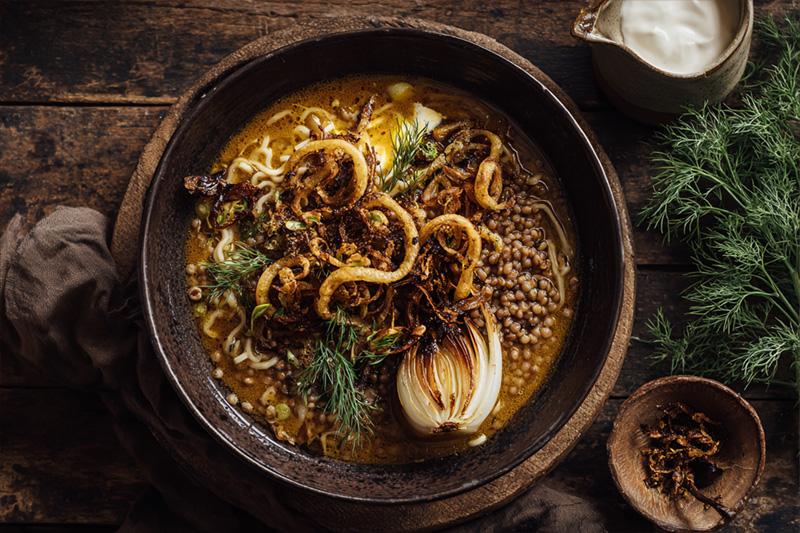

Buckwheat is one of those ingredients that shows up in cuisines across the globe and rarely gets credit for how interesting it actually is. In Russia and Eastern Europe it's called kasha when toasted and cooked as a grain porridge, a staple that fed armies and peasants for centuries and developed a reputation for being filling and serious and not particularly glamorous, which undersells it the same way people undersell polenta by leading with the nutrition and forgetting to mention the flavor. Toasted buckwheat has this specific deep, nutty character that sits somewhere between roasted coffee and caramelized onion, and adding it to a ramen broth is the kind of cross-cultural application that feels completely logical once you've done it once. Roasted garlic is the other ingredient this bowl is built on, a full head squeezed into the broth base after forty minutes in the oven, where it becomes sweet and spreadable and completely different from its raw self. This is a vegan bowl that tastes like it took much longer than it did, and the kind of deeply warming thing that makes sense on any night when the weather has an opinion.
Buckwheat toasts then swells—roasted garlic melts in broth—noodles carry earth
Let Me Tell You...
Buckwheat is one of those grains that gets the shortest end of the reputation stick in American cooking, mostly because the only context most people encounter it in is buckwheat pancakes, which are fine but do not represent the ingredient's full range or its status in Eastern European kitchens where it has been a daily presence for several centuries.
In Russia, kasha made from toasted buckwheat is the equivalent of what rice is in Japan or what bread is in France, a fundamental staple that shows up at breakfast and dinner and everywhere in between and carries the kind of cultural weight that's hard to understand if you grew up eating it as a novelty ingredient in health food store bulk bins.
Toasted buckwheat has this deep, specific nuttiness that smells like something between a coffee roaster and a bakery, and it develops that aroma in a dry skillet in about four minutes, which is one of the better and more underrated kitchen smells.
Pre-toasted kasha exists, but toasting fresh buckwheat yourself builds the aroma this broth depends on.
Roasted garlic is what happens when you put the most aggressive allium in the kitchen in foil in an oven for forty minutes and come back to something completely different: sweet and spreadable and almost caramelized, with almost none of the sharpness and all of the depth.
A full head roasted and squeezed directly into the broth base dissolves into it over a short simmer and gives the finished bowl this rounded, complex garlic sweetness that you'd spend the rest of the meal trying to identify if you didn't know what went in.
The caraway seeds and smoked paprika are the Eastern European accent notes that place this bowl somewhere specific rather than ambiguously rustic.
The forty-minute oven time and the twenty-minute broth simmer overlap almost perfectly, and multitasking both simultaneously is what makes this a weeknight recipe rather than a weekend project. The buckwheat goes into the simmering broth rather than being cooked separately, which means it absorbs the garlic broth as it cooks and thickens it from the inside in the same way that lentils or oats thicken a soup, making the finished liquid more substantial and coating the ramen noodles differently than a thin broth could.
This is the same instinct behind Eastern European grain-based soups and Japanese dishes that use starchy ingredients to give broth a body and presence it couldn't develop from bones or aromatics alone.
The fresh dill over the top is the Slavic flourish that no other herb could replace without changing the zip code of the bowl, and it's non-negotiable for the same reason that sesame is non-negotiable in a Japanese bowl.
It absorbs liquid aggressively and the consistency changes noticeably between the 15-minute mark and the 18-minute mark.
This is the bowl for a winter evening when you want something that feels ancient and deliberate and deeply warming without any irony, and the combination of toasted buckwheat, roasted garlic, and ramen noodles is the kind of thing that seems unlikely until you eat it and realize it was always obvious.
The dill over the top is the moment where the Eastern European character of the bowl announces itself without apology, and the whole thing smells like somebody's grandmother made dinner somewhere between Moscow and Tokyo, which is exactly the kind of impossible kitchen you want to be eating in.
Ingredients
- 6 oz dried ramen noodles (2 bricks, seasoning packets discarded)
- 1/2 cup whole buckwheat groats (raw, not pre-cooked kasha)
- 1 whole head of garlic, top 1/4 inch sliced off to expose the cloves
- 4 cups low-sodium vegetable broth, plus more as needed
- 1 medium yellow onion, finely diced
- 2 tablespoons olive oil, divided
- 1 tablespoon low-sodium soy sauce
- 1 teaspoon apple cider vinegar
- 1/2 teaspoon smoked paprika
- 1/2 teaspoon caraway seeds
- 2 tablespoons fresh dill, roughly chopped (for serving)
- Kosher salt and freshly ground black pepper, to taste
Preparation
- Preheat the oven to 400°F. Place the garlic head cut-side up on a piece of foil. Drizzle with 1/2 tablespoon of the olive oil and wrap tightly in the foil. Roast for 35-40 minutes until the cloves are completely golden, soft, and caramelized. Remove from the oven and let cool slightly before handling.
- While the garlic roasts, heat a small dry skillet over medium heat. Add the buckwheat groats and toast, stirring constantly, for 3-4 minutes until they darken slightly and smell nutty. Remove from heat and set aside.
- Heat the remaining olive oil in a medium pot over medium heat. Add the diced onion and cook, stirring occasionally, for 6-7 minutes until golden and soft. Add the smoked paprika and caraway seeds and stir for 1 minute until fragrant.
- Unwrap the roasted garlic and squeeze the softened cloves directly from their skins into the pot. Mash them into the onion mixture with the back of a wooden spoon or a fork until mostly smooth. Add the vegetable broth, soy sauce, and apple cider vinegar. Stir well and bring to a simmer over medium heat.
- Add the toasted buckwheat groats to the simmering broth. Reduce heat to medium-low and simmer uncovered for 15-18 minutes, stirring occasionally, until the buckwheat is tender and has thickened the broth noticeably. Add a splash more broth if it becomes too thick. Season generously with salt and pepper.
- Bring a separate pot of salted water to a boil. Cook the ramen noodles for 2-3 minutes until just tender. Drain.
- Divide the noodles between bowls. Ladle the roasted garlic and buckwheat broth generously over the noodles. Finish with the fresh dill and serve immediately with any optional toppings alongside.