
Miso Eggplant Ramen
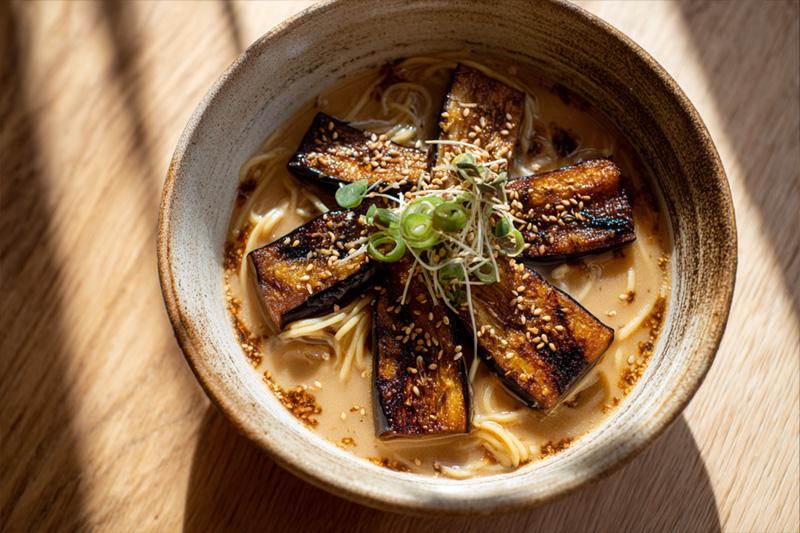

Nasu dengaku, miso-glazed eggplant, is one of those Japanese dishes that proves vegetables can be just as satisfying as meat when you treat them right. The slender Japanese eggplants get scored and roasted until they're creamy and soft inside, then glazed with a sweet-savory miso mixture that caramelizes into a sticky, burnished coating. The eggplant flesh turns silky and almost custardy, absorbing all that umami from the miso glaze. Serving it over ramen in a simple dashi broth lets the eggplant be the star while giving you noodles to slurp and broth to sip. It's elegant vegetarian cooking that doesn't sacrifice any of the satisfaction you'd get from a bowl of meat ramen.
Purple turns to gold—miso sings its salty song—silk hides in the flesh.
Let Me Tell You...
I became obsessed with miso-glazed eggplant after eating it at a tiny izakaya in Tokyo where the cook seemed personally offended by the concept of menus and just made whatever he felt like that night.
The eggplant arrived without announcement, two halves of something I didn't recognize, glazed with something that smelled incredible and was still bubbling from the broiler.
When I cut into it and the flesh yielded like butter, sweet and savory and completely transformed from anything I associated with eggplant, I understood why Japanese cooking has such reverence for vegetables.
This helps the miso glaze penetrate deeper into the flesh.
Japanese eggplants are essential here because they're sweeter and less bitter than the globe eggplants you find at most American grocery stores, and their slender shape makes them perfect for halving and glazing.
You score the flesh in a crosshatch pattern, which looks pretty but also serves a purpose, creating channels for the miso glaze to seep into as the eggplant roasts.
The first roasting softens the flesh, then the glaze goes on and the eggplant goes back under the broiler until everything caramelizes into a sticky, burnished coating.
Red miso is too strong and will overpower the delicate eggplant flavor.
The miso glaze is simple, just miso paste mixed with mirin and a little sugar to help it caramelize, but getting the consistency right matters.
It should be thick enough to cling to the eggplant but thin enough to brush on evenly.
Some recipes add sake or dashi to thin it out, but I find that mirin provides enough liquid while also adding sweetness.
Watch it carefully under the broiler because the sugar can go from caramelized to burnt in about ten seconds.
The glaze burns quickly once it starts caramelizing.
This ramen is what I make when I want something that feels restaurant-quality but is actually pretty simple, the kind of dish that impresses people who don't know how easy it is.
The eggplant looks beautiful, glossy and golden with those crosshatch marks, and the dashi broth underneath is clean and subtle, letting the umami from the miso glaze shine.
It's vegetarian food that doesn't apologize or make excuses, just good cooking that happens to not have meat in it.
Ingredients
- 2 packages ramen noodles (discard seasoning packets)
- 4 Japanese eggplants (or 2 small Italian eggplants)
- 4 cups dashi stock
- 3 tablespoons white or yellow miso paste
- 2 tablespoons mirin
- 1 tablespoon sugar
- 1 tablespoon vegetable oil
- 1 tablespoon soy sauce
- 2 green onions, thinly sliced
- 1 tablespoon toasted sesame seeds
- Shichimi togarashi, for serving (optional)
Preparation
- Preheat the oven to 400°F (200°C). Line a baking sheet with parchment paper.
- Cut the Japanese eggplants in half lengthwise. Score the flesh in a crosshatch pattern, cutting about 1/2-inch deep but not through the skin.
- Brush the cut sides of the eggplants with vegetable oil and place cut-side down on the baking sheet. Roast for 15 minutes until the flesh is softened.
- While the eggplants roast, make the miso glaze. In a small bowl, whisk together the miso paste, mirin, and sugar until smooth.
- Remove the eggplants from the oven and flip them cut-side up. Turn on the broiler.
- Brush the miso glaze generously over the cut surface of each eggplant half, making sure it gets into the scored grooves.
- Broil 6 inches from the heat for 3-5 minutes, watching carefully, until the glaze is bubbling and caramelized with some dark spots. Remove immediately to prevent burning.
- While the eggplant broils, bring the dashi stock to a gentle simmer. Stir in the soy sauce. Keep warm.
- Cook the ramen noodles according to package instructions. Drain and divide between two serving bowls.
- Ladle the warm dashi broth over the noodles. Place two glazed eggplant halves on top of each bowl.
- Garnish with sliced green onions and toasted sesame seeds. Serve with shichimi togarashi on the side.