
Pheasant Consomme Ramen
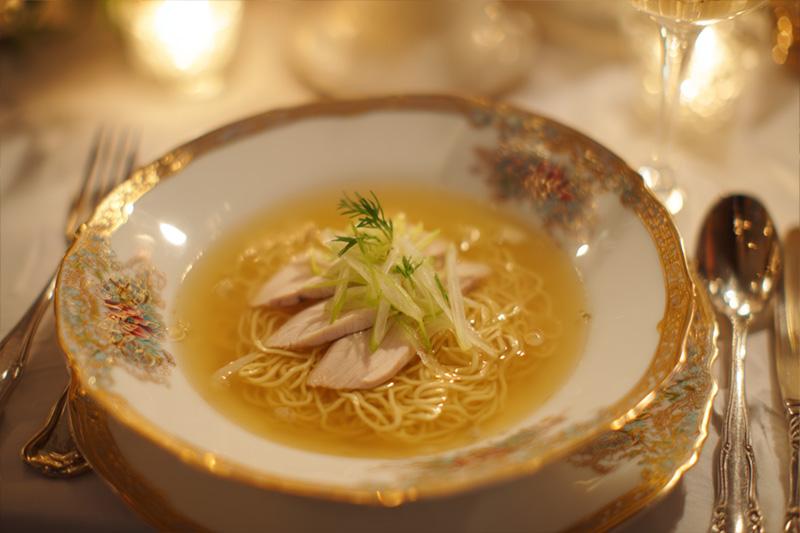
There's a certain kind of food that makes you feel like you should be wearing a blazer just to eat it, and pheasant consomme is absolutely that food. A proper consomme is one of those things culinary school instructors use to separate the serious students from the ones who are just there for the knife skills demo. You build a stock from a whole pheasant, then you spend another hour clarifying it with an egg white raft until you end up with something so transparent and golden it looks like it was poured through a prism. The payoff, though, is a broth with a depth you genuinely can't get any other way. Ramen noodles in all of this feels slightly audacious, maybe even disrespectful to the French tradition, but the noodles do something the classic garnish cuts never could, which is give the whole bowl a kind of body and heft that makes it a real dinner rather than an amuse-bouche. If you're doing a winter dinner party and want to make the kind of first course people talk about for a week, this is it.
Let Me Tell You...
The first time I tried to make a consomme, I did not understand why the recipe kept insisting I not stir it.
I stirred it, obviously, because I am the kind of person who cannot leave a pot alone, and what I ended up with was a cloudy, grayish broth that tasted fine but looked like something you'd drain from a radiator.
Clarification is unforgiving like that, and pheasant consomme is one of the few dishes that will straight-up punish you for not trusting the process.
Touch it and you're starting over.
Resist. The egg white raft is the strangest, most patient thing in classical French cooking.
You beat egg whites with ground pheasant meat and mirepoix into a paste, stir it into cold stock, bring it up slowly over medium heat, and then watch as a gray, lumpy mass rises to the top and starts collecting every single impurity in the liquid.
It looks terrible the entire time it's happening.
You stand there wondering if you've destroyed the stock, which by this point has taken you the better part of an afternoon to build from a whole bird you had to break down yourself.
The moment you ladle through the raft and see clear amber liquid coming through, it's a legitimate small triumph.
Warm stock will cook the egg whites before they can do their clarifying work.
Pheasant sits in this interesting culinary territory between chicken and duck, leaner than both but with a genuine wildness to the flavor that deepens in the broth.
I poach the breast separately in the finished consomme rather than in plain water because the meat absorbs the flavor and gives something back in return, a small exchange of tenderness for depth.
The chervil you scatter on top at the end is not optional even though it looks optional.
It smells like anise and spring and it's the one thing cutting through all that golden richness, and without it the bowl is technically perfect but emotionally incomplete.
Thin, clean slices in consomme look intentional.
Thick ragged ones look like an accident.
Ramen noodles in a consomme are a commitment to a certain kind of audacity, the same way sneakers with a tuxedo are a statement and not a mistake.
You're taking a preparation that French cooks spent centuries perfecting and dropping something distinctly Japanese into it, and the remarkable thing is it works beautifully because the noodles are fine enough not to cloud the broth and firm enough to hold against it.
Cook them completely separate, rinse them cold, and lower them into the bowl gently so the consomme stays clear when it's poured over.
The whole bowl, when it's right, looks like something from a restaurant you'd need a reservation three weeks out to get into, and you made it in your own kitchen, which is the kind of thing that still gets me even after all of it.
Ingredients
- 1 whole pheasant (about 2.5 lbs), backbone removed, breast reserved, carcass and legs used for stock
- 12 cups cold water
- 2 medium carrots, peeled and roughly chopped (divided: half for stock, half for raft)
- 2 celery stalks, roughly chopped (divided: half for stock, half for raft)
- 1 medium yellow onion, halved (divided: half for stock, half for raft)
- 1 bouquet garni (3 parsley sprigs, 2 thyme sprigs, 1 bay leaf, tied in cheesecloth)
- 1 teaspoon whole black peppercorns
- Kosher salt, to taste
- 4 large egg whites
- 1 tablespoon tomato paste
- 8 ounces dried thin ramen noodles (2 bricks, seasoning packets discarded)
- 1 medium leek, white and pale green parts only, julienned
- 2 teaspoons white truffle oil (or 4-6 thin fresh truffle shavings if available)
- 1 small bunch fresh chervil, leaves picked
- Flaky sea salt, to finish
Preparation
- Break down the pheasant: Remove the breast (with skin) and set aside in the refrigerator. Separate the legs and wings. Place the carcass, legs, wings, half the carrots, half the celery, and half the onion in a large stockpot. Cover with 12 cups cold water and bring to a bare simmer over medium heat. Skim foam aggressively for the first 10 minutes.
- Add the bouquet garni and peppercorns. Reduce heat to low and simmer uncovered for 90 minutes, skimming occasionally. The stock should barely tremor, not boil. After 90 minutes, strain through a fine-mesh strainer lined with cheesecloth into a clean pot. Discard solids. Season the stock lightly with kosher salt. You should have about 8 cups. Let cool to room temperature, then refrigerate for 30 minutes until cold.
- While the stock cools, make the clarification raft: Finely mince the remaining carrots, celery, and onion. Combine with the egg whites and tomato paste in a bowl and beat together until well blended and slightly frothy. Season lightly with salt.
- Pour the cold stock into a clean wide pot. Add the egg white mixture and stir gently to combine. Place over medium heat and do not stir again. As the stock warms, the egg white raft will gradually rise. Continue heating until you see the raft solidify and the stock just below it begins to simmer gently, about 20-25 minutes. Make a small hole in the raft with a ladle and maintain a gentle simmer for 15 more minutes.
- Carefully ladle the consomme through the hole in the raft into a clean pot lined with a double layer of damp cheesecloth. Do not press or squeeze. The resulting liquid should be crystal-clear and amber-gold. Taste and adjust salt. Keep warm over very low heat.
- Poach the pheasant breast: Season the reserved breast with salt. Lower it gently into the hot consomme and poach over low heat (barely simmering, around 160-170°F) for 18-22 minutes until just cooked through and firm to the touch. Remove carefully, let rest 5 minutes, then slice thin on a bias against the grain. Discard the skin. Keep consomme warm.
- Cook ramen noodles in a separate pot of salted boiling water for 2-3 minutes until just tender. Drain and rinse under cold running water until cool to stop cooking. Divide noodles between warmed serving bowls.
- Blanch the julienned leek: Drop leek strips into the salted boiling noodle water for 30 seconds, then transfer immediately to ice water. Drain and pat dry.
- Assemble each bowl: Arrange sliced pheasant breast over the noodles. Add a small mound of blanched julienned leek. Ladle 1.5 to 2 cups of hot consomme gently over the top. Drizzle lightly with truffle oil, scatter fresh chervil leaves over the surface, and finish with a pinch of flaky sea salt.