
Berbere Chicken Ramen
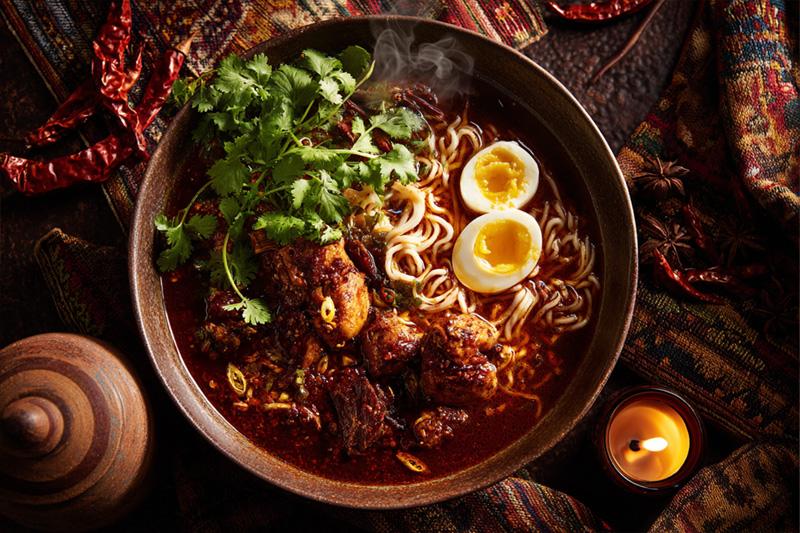

Berbere is one of those spice blends that makes you quietly question every single-spice approach you have ever taken to cooking. It is hot and dark and complex in a way that builds gradually rather than hitting you once and leaving, which is the kind of heat that actually makes you want more. The blend varies by household and by region in Ethiopia, but the constants are dried chilies, fenugreek, and a warming combination of allspice and cinnamon that most people do not expect to find in something this savory. When you use berbere as both a rub and a broth foundation in the same recipe, you get two distinct experiences of the same spice: the charred, intense version on the surface of the chicken, and the slower, mellower version dissolved into the broth. The ramen noodles would get exactly zero approval from any Ethiopian grandmother, but they absorb the brick-red broth in a way that injera approaches differently, and it works in its own particular way.
Berbere clings deep—Chicken chars at the edges—The stove has no shame
Let Me Tell You...
I had no idea what berbere was until I ate tibs at an Ethiopian restaurant in Oakland and spent the following three days trying to figure out what that dark, aromatic, deeply hot thing coating the meat actually was.
The answer turned out to be a spice blend with roots in Ethiopian Christian liturgical tradition, which is not something I expected a spice mix to have, but there it is.
It is made from dried chilies, fenugreek, coriander, allspice, cinnamon, ginger, and several other spices depending on who is making it, and the result is something that builds heat slowly and keeps going long after you think it has peaked.
Pre-ground blends lose their volatile aromatics fast. Toast, grind, and use immediately.
The chicken in this recipe gets both rubbed and braised in berbere, which means you get two different expressions of the same spice in the same bowl.
The rubbed surface chars slightly in the hot pan, giving you a dark, almost smoky crust with concentrated heat.
The berbere that goes into the broth mellows as it simmers, losing some of the raw edge but gaining something deeper and more rounded.
Those two versions of the same spice in one bowl are what make this more than a novelty.
One hits you fast; the other stays with you.
Sear in a single layer over high heat.
Steam makes pale, sad chicken with no crust, and the crust is where the flavor lives.
The broth builds on the pan drippings, sweated onion, garlic, ginger, and tomato paste, which is a recognizable starting point for many Ethiopian wats and stews.
You add broth and let it pull together into something brick-red and deeply aromatic, and then the chicken goes back in for the final few minutes to finish cooking and pick up more of the sauce.
It is the kind of broth that makes the whole apartment smell like something significant is happening, and it does not disappoint on delivery.
It rounds out the spice and gives the broth a richness that makes it feel finished rather than just hot.
I want to acknowledge the ramen part of this directly, because it is the obvious question.
Ethiopian food traditionally uses injera as the starch: a sour, spongy teff flatbread that absorbs sauce in a way that is designed into the whole structure of the meal.
Ramen noodles do not do the same thing, but they hold the broth close in the space between the strands and carry it to each bite in a way that is different and, in this context, genuinely useful.
The berbere does not object. This bowl is very good.
Ingredients
- 1 lb boneless skinless chicken thighs, cut into 1.5-inch pieces
- 8 ounces dried ramen noodles (2 bricks, seasoning packets discarded)
- 3 tablespoons berbere spice blend (store-bought or homemade), divided
- 1 medium yellow onion, finely diced
- 4 garlic cloves, minced
- 1 tablespoon fresh ginger, grated
- 2 tablespoons tomato paste
- 3 cups low-sodium chicken broth
- 2 tablespoons neutral oil, for searing
- 1 tablespoon unsalted butter
- Kosher salt, to taste
- Fresh cilantro, roughly chopped, for serving
Preparation
- Toss the chicken pieces with 2 tablespoons of the berbere spice blend and a generous pinch of kosher salt. Let sit while you prep the remaining ingredients, at least 5 minutes.
- Heat 2 tablespoons neutral oil in a large, wide pot or Dutch oven over high heat until shimmering. Add the chicken pieces in a single layer, working in batches if needed, and sear for 3 to 4 minutes per side until deeply browned with dark, charred edges. Transfer to a plate and set aside.
- Reduce heat to medium. Add the diced onion to the same pot and cook, stirring occasionally, for 5 minutes until softened and beginning to turn golden. Add the garlic and ginger and cook for 1 minute until fragrant. Add the tomato paste and remaining 1 tablespoon berbere and stir for 2 minutes until the paste darkens slightly.
- Pour in the chicken broth and scrape up any browned bits from the bottom of the pot. Bring to a boil, then reduce to a steady simmer. Return the seared chicken pieces to the pot, cover partially, and simmer for 15 minutes until the chicken is cooked through and the broth has deepened in color and flavor. Stir in the butter until melted. Taste and adjust salt.
- Bring a large pot of salted water to a boil. Cook ramen noodles for 2 to 3 minutes until just tender. Drain and divide evenly between 2 to 4 bowls.
- Ladle the hot broth and chicken generously over the noodles in each bowl. Top with fresh cilantro and any optional toppings. Serve immediately with extra berbere on the side for those who want more heat.