
Halloumi Herb Ramen
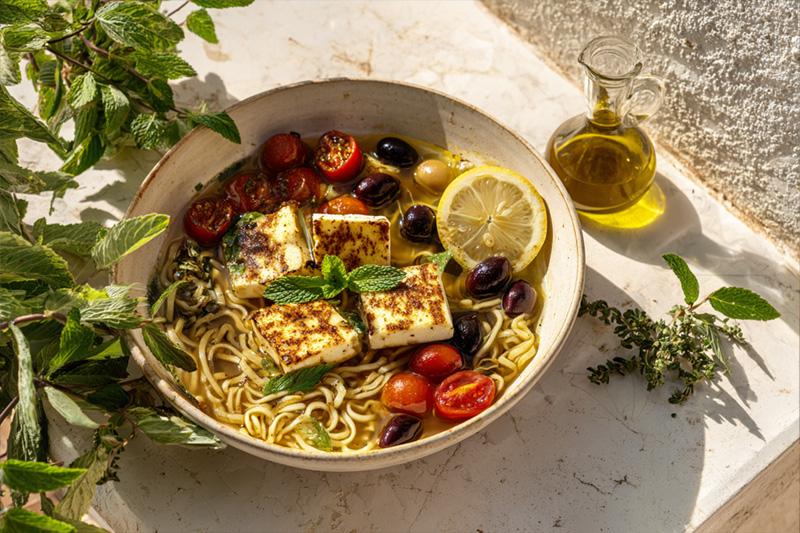
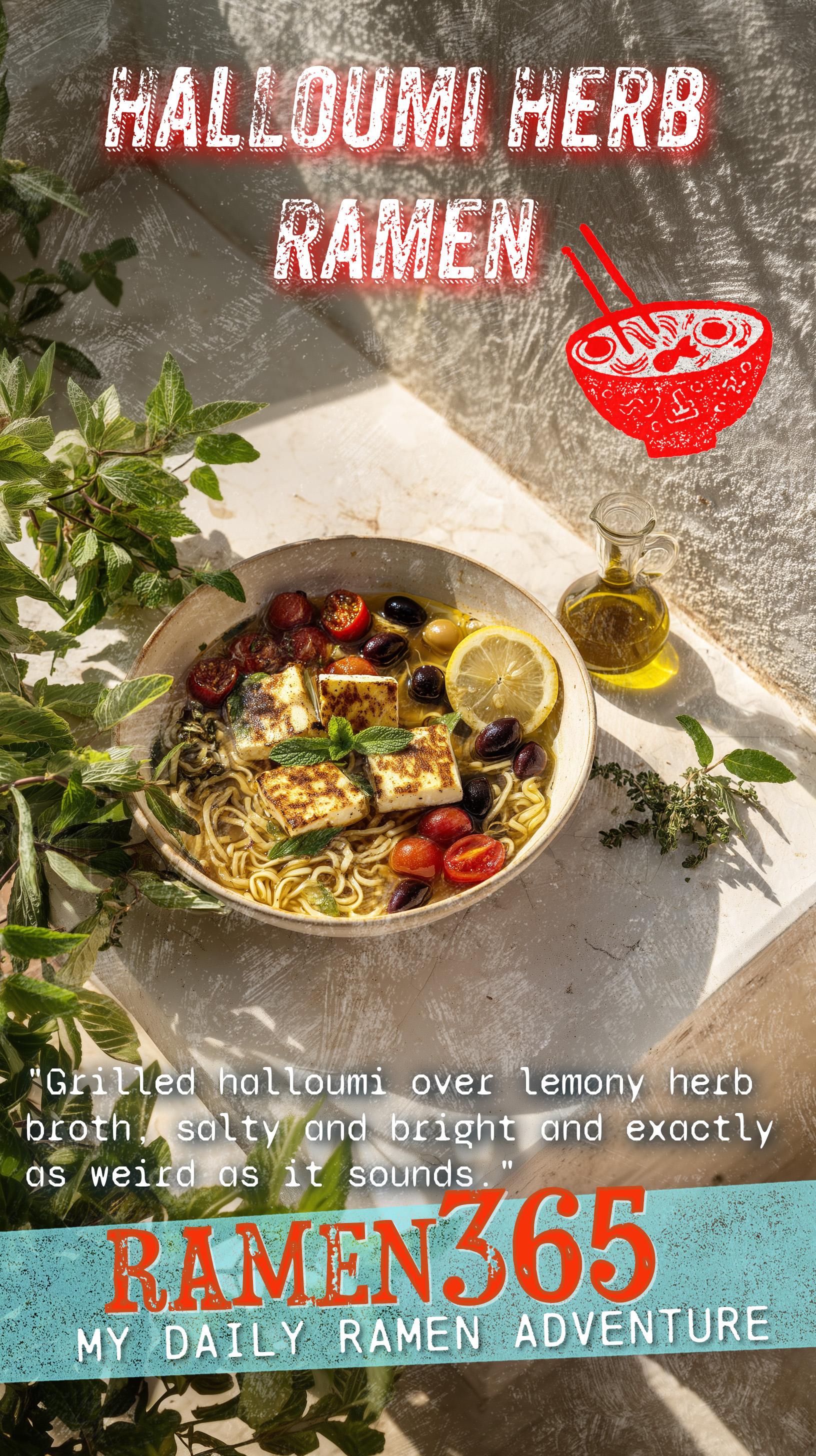
Halloumi is the cheese that decided it had better things to do than melt. Its unusually high melting point, the result of a specific curd-heating process used in Cyprus, means you can put it directly in a hot dry pan and it will develop a golden, slightly crispy exterior while holding its shape completely rather than running across the pan in a puddle. This is an extremely useful property for a bowl of ramen, where you want a cheese that behaves more like a protein than a condiment. The broth for this recipe is lighter than most ramen broths, built on vegetable stock, lemon, and fresh herbs, which means the halloumi is the thing doing the heavy savory lifting. The mint is not optional and is not decoration: it cuts through the salt of the cheese in a way that oregano and parsley alone cannot do, and it is the ingredient that makes this bowl taste specifically Greek rather than just Mediterranean in a general sense.
Pan-fried and golden—Halloumi holds its shape well—Mint cuts through the salt
Let Me Tell You...
I ate halloumi for the first time at a Greek restaurant where it came out on a plate alone, grilled and slightly squeaky and aggressively salty, with a few lemon wedges and some pita on the side, and I thought: this is what I want in a ramen bowl.
Not because ramen and Greek cheese are natural companions in any traditional sense, but because the properties of halloumi that make it interesting as a standalone dish are exactly the properties that make it useful in a broth.
It holds up.
It does not disappear.
It stays there and contributes.
Thinner slices dry out and get tough; thicker ones do not develop enough crust before the inside gets rubbery.
The squeakiness of halloumi, which people either find charming or mildly alarming, comes from the intact protein strands in the curd. When you sear it in a hot dry pan, the surface proteins caramelize and the squeakiness mostly resolves into something with a firm, slightly springy texture and a golden exterior.
You want the pan hot and dry, meaning no oil, which is counterintuitive but correct: halloumi has enough fat content to cook itself, and added oil mostly just smokes and splashes.
The cheese will release easily from the pan when it is ready to flip, and it will resist releasing if it is not.
Let it tell you when to flip.
The cheese has enough natural fat to sear properly on its own.
Oil just causes splatter and uneven browning.
The broth is made to support rather than compete with the halloumi, which means it needs to be bright and clean rather than rich and complex.
Vegetable stock, lemon juice, a smashed garlic clove, fresh oregano, and a generous pinch of dried thyme come together into something that tastes like a bowl of Greek countryside in a specific and entirely positive way.
The lemon is added at the end, like the yuzu in the maitake bowl, because acid loses its brightness under prolonged heat.
Cooked lemon juice tastes flat; fresh lemon juice tastes alive.
The mint is the finishing move, and I want to be clear about this: fresh mint, not dried, and not a small amount.
You want a handful of torn mint leaves scattered over the top of the bowl where they will wilt slightly in the steam but not disappear completely, because the contrast between the salty, golden halloumi and the cool, faintly sweet herb is the whole point of the bowl and you should not undercut it by using too little.
Ingredients
- 8 ounces halloumi cheese, sliced into 1/3-inch planks
- 8 ounces dried ramen noodles (2 bricks, seasoning packets discarded)
- 3 cups low-sodium vegetable broth
- 2 tablespoons fresh lemon juice (about 1 large lemon), added after cooking
- 1 teaspoon lemon zest
- 2 garlic cloves, smashed
- 2 sprigs fresh oregano (or 1/2 teaspoon dried)
- 1/2 teaspoon dried thyme
- 1 tablespoon olive oil, for broth base
- 1/4 cup Kalamata olives, pitted and halved
- 1/2 cup cherry tomatoes, halved
- Fresh mint leaves, torn, for serving (about 1/4 cup packed)
- Black pepper, to taste
Preparation
- Heat 1 tablespoon olive oil in a medium saucepan over medium heat. Add the smashed garlic, oregano sprigs, and dried thyme. Cook, stirring, for 1 to 2 minutes until fragrant. Add the vegetable broth and bring to a gentle simmer. Add the cherry tomatoes and Kalamata olives and simmer for 8 to 10 minutes until the tomatoes have softened and released their juices into the broth. Remove oregano sprigs. Remove from heat and stir in lemon juice and lemon zest. Keep warm.
- Heat a dry cast-iron or stainless-steel skillet over medium-high heat until very hot. Place the halloumi planks in the dry pan in a single layer without crowding. Cook undisturbed for 2 to 3 minutes until a golden, caramelized crust forms on the underside. The cheese will release naturally when it is ready. Flip and cook for 2 minutes more until golden on the second side. Transfer to a plate.
- Bring a large pot of salted water to a boil. Cook ramen noodles for 2 to 3 minutes until just tender. Drain and divide evenly between 2 to 4 bowls.
- Ladle the hot herb-lemon broth, tomatoes, and olives over the noodles in each bowl. Arrange 2 to 3 halloumi planks on top. Scatter torn fresh mint leaves generously over everything. Add black pepper to taste and any optional toppings. Serve immediately.