
Maitake Yuzu Ramen
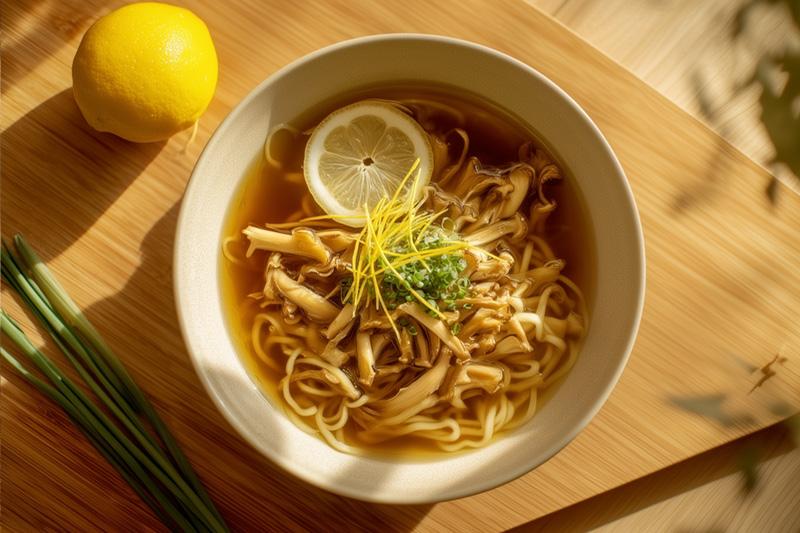

Maitake mushrooms have a particular quality that is hard to explain to someone who has only met them dried: when fresh and sauteed in a hot pan, they develop a golden, slightly crispy edge while staying tender in the center, and they taste more deeply of the forest than almost any other cultivated mushroom you will find. The name means hen of the woods in Japanese, which is accurate in the same way that a description can be technically correct but still miss the whole point of the thing. The yuzu is the other half of this bowl, and it matters more than the amount you use might suggest. Just a tablespoon or two of fresh yuzu juice squeezed into the broth right before serving lifts the entire bowl from earthy to something brighter and more interesting, the way a squeeze of lemon changes a bowl of soup in a way that you cannot quite name but would definitely miss if it were absent. This is a vegetarian bowl that does not need to apologize for being vegetarian.
Maitake dances—Yuzu cuts through forest fog—The wok smells like rain
Let Me Tell You...
Maitake mushrooms look like something that grew in a fairy tale and then agreed to be photographed for a cookbook.
They come in big, overlapping fronds that are brownish-gray on top and pale underneath, and when you tear them by hand into smaller pieces rather than cutting them, the edges have a natural roughness that crisps up beautifully in a hot pan.
I discovered this by accident the first time I made them, when I tore them instead of slicing them because the knife I wanted was dirty.
The torn edges became the best part of the whole dish.
The irregular edges brown and crisp faster and give you more surface area to work with.
The dashi is the part of this recipe that rewards a little extra effort.
You could use store-bought dashi powder and it would be fine, but if you have fifteen minutes and a piece of kombu and a handful of katsuobushi, the homemade version has a clarity and depth that the powder does not fully replicate.
It is not a complicated process: you soak the kombu in cold water, bring it to just below a simmer, pull it out, add the bonito flakes, steep for a few minutes, and strain.
What you get is a broth that tastes like the ocean thought about becoming a mushroom.
Pull it from the water just before bubbles form at the bottom of the pot, around 140 degrees Fahrenheit.
Boiling makes the dashi bitter.
The yuzu goes in at the very end, which is important.
Yuzu juice loses its brightness quickly under heat, so you add it after pulling the broth off the burner.
The same principle applies to yuzu zest: grate it directly over the bowl at serving rather than stirring it into the hot broth.
The difference between yuzu added early and yuzu added at the last moment is not subtle: one tastes like citrus, the other tastes like memory.
For the zest, substitute Meyer lemon, which is the closest available approximation in both fragrance and brightness.
This bowl asks very little of you and gives quite a lot back.
The maitake does most of the heavy lifting in terms of flavor and texture, the dashi provides structure, and the yuzu makes the whole thing feel alive.
It is the kind of vegetarian ramen that you make not because you have to but because you actually want to eat it, which is the standard all vegetarian ramen should be held to and which this one clears without any trouble.
Ingredients
- 8 ounces fresh maitake mushrooms, torn by hand into 2 to 3-inch fronds
- 8 ounces dried ramen noodles (2 bricks, seasoning packets discarded)
- 4 cups prepared dashi (kombu-bonito or store-bought, for vegetarian use kombu-only dashi)
- 2 tablespoons fresh yuzu juice (or bottled yuzu juice)
- 1 teaspoon yuzu zest, for finishing (or Meyer lemon zest)
- 2 tablespoons low-sodium soy sauce
- 1 tablespoon mirin
- 1 teaspoon toasted sesame oil
- 2 tablespoons neutral oil, for sauteing mushrooms
- 2 garlic cloves, minced
- 3 green onions, thinly sliced
- Kosher salt, to taste
Preparation
- Heat 2 tablespoons neutral oil in a large skillet over medium-high heat until shimmering. Add the torn maitake mushroom fronds in a single layer. Cook undisturbed for 3 to 4 minutes until the undersides are golden and beginning to crisp. Season with a pinch of salt, toss gently, and cook for 2 more minutes. Add the minced garlic, stir, and cook for 1 minute until fragrant. Remove from heat and set aside.
- In a medium saucepan, combine the dashi, soy sauce, and mirin. Bring to a gentle simmer over medium heat. Taste and adjust seasoning with salt if needed. Remove from heat and stir in the yuzu juice. Do not return to the burner after adding yuzu.
- Bring a large pot of salted water to a boil. Cook ramen noodles for 2 to 3 minutes until just tender. Drain and drizzle with the toasted sesame oil to prevent sticking. Divide evenly between 2 to 4 bowls.
- Ladle the hot yuzu-dashi broth over the noodles in each bowl. Arrange the sauteed maitake mushrooms on top. Finish with sliced green onions and fresh yuzu or Meyer lemon zest grated directly over the bowl. Add optional toppings as desired and serve immediately.